

Maintaining your own IT infrastructure gives your business control over its hardware and systems, but it also requires suitable space, reliable power, cooling, network connectivity, and physical security. Building a private data center can be expensive and complex, while cloud services may not always be suitable for organizations with specific hardware, performance, or security requirements.
Colocation offers a middle ground. Your company retains ownership and control of its servers while housing them in a professional data center and using the facility's infrastructure.
In this article, we'll look at how colocation works, its main benefits and limitations, and what to consider when choosing a provider.
Key Takeaway:
With colocation, companies place their own servers and equipment in a professional data center, where they have access to the necessary power, cooling, network connectivity, and physical security. This allows them to retain control over their hardware without investing in building and maintaining their own data center.
What Are Colocation Data Centers?
With colocation, customers rent a specific amount of space in a data center based on the size and requirements of their infrastructure. This may range from space for individual servers to a full cabinet or a larger private area. The provider supplies the environment required to operate the equipment, including power, cooling, network connectivity, and physical security.
Responsibility for the hardware itself remains primarily with the customer. The customer selects and configures the equipment, manages operating systems and applications, and plans any necessary changes or expansions.
The provider, in turn, maintains the environment in which these systems operate. This gives businesses access to professional infrastructure without taking on the costs and technical requirements of building their own data center.
How Is Colocation Used in Practice?
Colocation services can be adapted to the size of the infrastructure and the specific requirements of the business. A company may start with a few rack units (U), rent a full cabinet, or use a dedicated private cage for larger deployments. Additional space, power capacity, and network connectivity can be added as needed.
The service includes power supply and network connectivity, and as the infrastructure grows, the space used can be increased as needed.
When physical intervention is required, many providers also offer Remote Hands services.
When physical intervention is required, many providers also offer Remote Hands. On-site technicians can, for example, reboot a server, check a cable connection, perform a visual inspection of the equipment, or assist in diagnosing a hardware problem. Depending on the scope of the service, they may also perform tasks such as replacing drives, cables, or other components. This is especially useful when the IT team is located elsewhere and cannot visit the data center.
Example: Imagine a company with servers housed in a data center in Sofia while its IT team works from another city. If a hardware issue occurs, an on-site technician can inspect the equipment, replace a pre-supplied component, or reboot the server without requiring a member of the company's staff to travel to the data center.
Benefits and Limitations of Colocation
Colocation combines hardware ownership and control with the advantages of a professional data center. It can provide a more reliable environment for critical systems while reducing some of the costs and technical responsibilities associated with maintaining the supporting infrastructure. However, the model also has limitations that should be considered in advance.
Greater Reliability
Professional data centers use redundant power systems, UPS units, generators, cooling, and network connectivity. If an individual component fails, redundant systems can continue supporting the equipment, reducing the risk of disruption to critical services.
Better Physical Security
Access to equipment is typically controlled through a combination of measures such as video surveillance, access control systems, on-site security, and environmental monitoring. Depending on the facility, additional layers of protection may also be available, including biometric identification and separate secure areas.
Predictable Environment for Growth
As requirements increase, businesses can expand the resources they use within the data center rather than investing in additional infrastructure of their own. This makes future capacity planning easier, particularly for organizations expecting their physical IT infrastructure to grow gradually.
Your Hardware Remains Your Responsibility
Colocation does not transfer server management to the provider. The customer remains responsible for selecting, purchasing, configuring, repairing, and replacing the equipment. This requires an in-house technical team or additional support services when the necessary expertise is not available internally.
Colocation, Cloud Hosting, or Your Own Infrastructure?
The choice depends primarily on how much control over the hardware is required, who will be responsible for maintaining it, and how easily resources need to scale. Colocation is suitable when a company wants to use its own equipment without building and maintaining all of the physical infrastructure around it.
Cloud hosting and dedicated servers shift more responsibility to the provider, while an on-premises data center offers the greatest level of control but also requires the most significant investment.
| Feature | Colocation | Cloud Hosting | Dedicated Server | On-Premises Data Center |
| Hardware ownership | Customer | Provider | Provider | Customer |
| Hardware maintenance | Customer | Provider | Provider | Customer |
| Data center maintenance | Provider | Provider | Provider | Customer |
| Scalability | High, but requires additional hardware | Very high | Moderate to high | Depends on available capacity |
| Upfront investment | Moderate to high | Low | Low | Very high |
| Control over hardware | Full | Limited | Limited | Full |
| Best suited for | Companies with their own hardware and specific requirements | Rapid deployment and flexible resource usage | Dedicated resources without owning hardware | Organizations requiring full control over the entire infrastructure |
In short, the main differences between colocation and the other options can be summarized as follows:
- Cloud hosting: cloud hosting is suitable when rapid deployment and flexible resource usage are priorities, without the need to own physical hardware. Colocation provides greater control over the specific equipment and its configuration.
- Dedicated server: with dedicated servers, the hardware is provided and maintained by the hosting provider. Colocation is more suitable when a company already owns its equipment or has specific requirements for its configuration.
- On-premises data center: this option provides control over both the hardware and the environment in which it operates, but requires significantly more resources to build and maintain. With colocation, the colocation provider provides this part of the infrastructure.
What Should You Check When Choosing Colocation?
When choosing a colocation service, it is important to compare not only the price but also the infrastructure behind it. Power and network reliability, physical security, expansion options, and technical support can directly affect the operation of your systems. Consider the following criteria:
- Power and cooling: Check how power redundancy, UPS systems, generators, and cooling are implemented, as well as what happens if a primary component fails.
- Network connectivity: Check which network carriers and connectivity options are available. Carrier-neutral data centers allow you to choose between different providers, which can improve network redundancy and flexibility.
- Physical security: Review the access control measures, video surveillance, on-site security, and environmental monitoring, as well as the procedures for accessing your equipment.
- Certifications and compliance: If your organization operates under specific regulatory or contractual requirements, check which standards and certifications the particular data center meets, such as ISO 27001, SOC 2, or PCI DSS.
- Technical support: Find out what on-site assistance is available, including whether Remote Hands services are offered, when they are available, and which tasks technicians can perform.
- Expansion options: Check whether additional rack space, power capacity, and network connections can be added as your requirements grow without having to relocate your infrastructure.
- SLA terms: Do not focus solely on the advertised uptime percentage. Review the guaranteed service levels, response times in the event of an issue, technical support terms, and the provider's responsibilities.
Conclusion
When planning for colocation, it is worth looking beyond the immediate need for server space. Future requirements for power, network connectivity, additional space, and technical support may change as your infrastructure develops. Planning for these requirements from the beginning can help avoid complex migrations or the need to switch providers later.
If you have decided that colocation is the right solution for your business, the next step is to choose a provider with resilient infrastructure and an enterprise-grade data center.
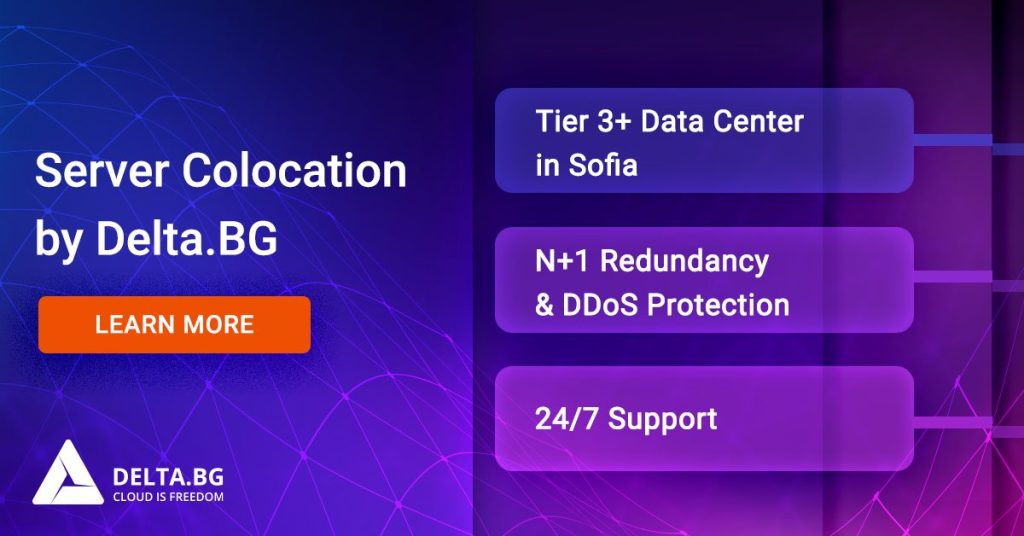
Delta provides colocation services from a Tier III+ Equinix data center in Sofia, with redundant power and cooling, enterprise-grade network connectivity, flexible rack space options, and 24/7 physical security for business-critical infrastructure.
If you would like to learn more about our colocation services or discuss your infrastructure requirements, contact us at support@delta.bg or call +359 2 4 288 288.