


Modern applications can be built as monolithic systems, microservices-based applications, or a combination of both. Each approach has its own strengths, and the right choice depends on factors such as application complexity, scalability requirements, and the way your team develops, deploys, and maintains software.
As containers and Kubernetes have become mainstream, many organizations have begun to question whether application servers still have a place in modern IT infrastructure. In reality, they continue to provide the runtime environment and essential services required by many enterprise applications. In this article, we'll compare monolithic architecture and microservices, explore the role of application servers, and help you choose the infrastructure that best fits your application's requirements.
Key Takeaway:
Monolithic architecture and microservices address different business and technical requirements, and neither approach is the right choice for every application. Monolithic applications are generally easier to develop and maintain, while microservices provide greater flexibility and allow individual services to scale independently. Regardless of the architecture you choose, application servers continue to provide the runtime environment required for enterprise applications running on Cloud VPS, Dedicated Servers, or Kubernetes.
What Is Monolithic Architecture?
Monolithic architecture is a software development approach in which an application is developed, deployed, and managed as a single unit. The user interface, business logic, and data layer share a single codebase and are deployed together as one package. Because all components run within the same application, they communicate directly without relying on network calls between separate services.
Despite the rapid adoption of modern cloud technologies, monolithic applications remain widely used for business systems, enterprise software, and many web applications. They provide a straightforward development model that simplifies the process of building, deploying, and maintaining software, particularly for small and medium-sized projects.
Advantages of Monolithic Architecture
- Simpler development: A single codebase makes it easier to develop, test, and troubleshoot applications.
- Simpler deployment: The entire application is deployed as a single unit, simplifying the deployment process.
- Easier testing: Because all components run together, integration and end-to-end testing are typically more straightforward.
- Simplified management: Managing a single application instead of multiple independent services reduces infrastructure complexity.
- Fast internal communication: Components communicate directly with one another, avoiding the additional latency associated with distributed systems.
Challenges of Monolithic Architecture
- Limited scalability: The entire application typically needs to be scaled, even when only a single component requires additional resources.
- More difficult code management: As the application grows, maintaining, developing, and understanding the codebase becomes increasingly challenging.
- Slower deployment cycles: Even small changes often require rebuilding, testing, and redeploying the entire application.
- Reduced fault isolation: An issue in one component can affect the stability or availability of the entire application.
The Role of Application Servers in Monolithic Architecture
Application servers provide the runtime environment required to run monolithic applications. They offer built-in capabilities such as request processing, session management, security, connection pooling, transaction management, and resource management. This allows developers to focus on implementing business logic instead of building these capabilities from scratch.
For enterprise applications built with technologies such as Jakarta EE or Java Servlets, application servers remain a core architectural component. They provide the reliable, secure, and stable runtime environment required to support business-critical applications.
Best Infrastructure for Monolithic Applications
For small and medium-sized monolithic applications, Cloud VPS offers an excellent balance of performance, flexibility, and cost efficiency. At Delta, our Cloud VPS platform provides guaranteed CPU resources, RAM, and storage in an isolated cloud environment, delivering predictable performance while allowing your infrastructure to scale as your project grows. As workloads increase, you can quickly expand your resources without migrating to a new hosting environment.
As applications become more complex or require additional processing power, memory, or storage, a Dedicated Server is the better choice. Dedicated hardware delivers consistent performance, complete resource isolation, and full control over your infrastructure, making it ideal for large enterprise applications and other resource-intensive workloads.
Our Delta Dedicated Server solutions provide fully dedicated hardware, complete administrative access, and customizable configurations tailored to the specific requirements of your applications.
What Is Microservices Architecture?
Microservices architecture is a software development model in which an application is divided into multiple independent services. Each service is responsible for a specific business capability, has its own codebase, and communicates with other services through APIs or messaging systems. This allows individual services to be developed, deployed, and scaled independently.
Microservices architecture is commonly used for large and complex applications that require frequent updates, high availability, and the ability to scale individual components independently. While this approach offers greater flexibility, it also requires a more sophisticated infrastructure and increased effort for management, automation, and monitoring.
Advantages of Microservices Architecture
- Independent scalability: Each service can scale according to its own requirements, enabling more efficient use of infrastructure resources.
- Faster deployments: Individual services can be updated and deployed independently without redeploying the entire application.
- Improved fault isolation: An issue in one service typically doesn't affect the operation of the remaining components.
- Greater development flexibility: Different teams can work on separate services simultaneously while choosing the technologies best suited to their specific requirements.
- Well suited for modern cloud environments: Microservices architecture integrates seamlessly with containers, CI/CD pipelines, and modern DevOps practices.
Challenges of Microservices Architecture
- More complex management: Managing multiple independent services requires more planning, automation, and monitoring.
- More complex service communication: Communication through APIs and messaging systems requires reliable networking, service discovery, and resilience mechanisms.
- More difficult data management: Maintaining data consistency across multiple independent services is significantly more challenging than in monolithic applications.
- Higher monitoring requirements: Troubleshooting distributed applications requires centralized logging, distributed tracing, and performance monitoring tools.
- More complex infrastructure: Running multiple services generally requires additional infrastructure components compared to monolithic applications.
How Application Servers Support Microservices
Although many microservices run inside containers, application servers continue to provide the runtime environment for services built with technologies such as Jakarta EE. They offer built-in capabilities for security, transaction management, connection pooling, and resource management, allowing developers to focus on business logic rather than implementing these features themselves.
In a microservices architecture, each service can run on its own application server. This enables services to be deployed, updated, and scaled independently while still benefiting from a reliable enterprise-grade runtime environment.
Why Is Kubernetes the Leading Platform for Container Management?
As the number of microservices grows, manually managing containers becomes increasingly difficult. Kubernetes automates deployment, scaling, networking, and container management, making it the preferred platform for managing containerized applications.
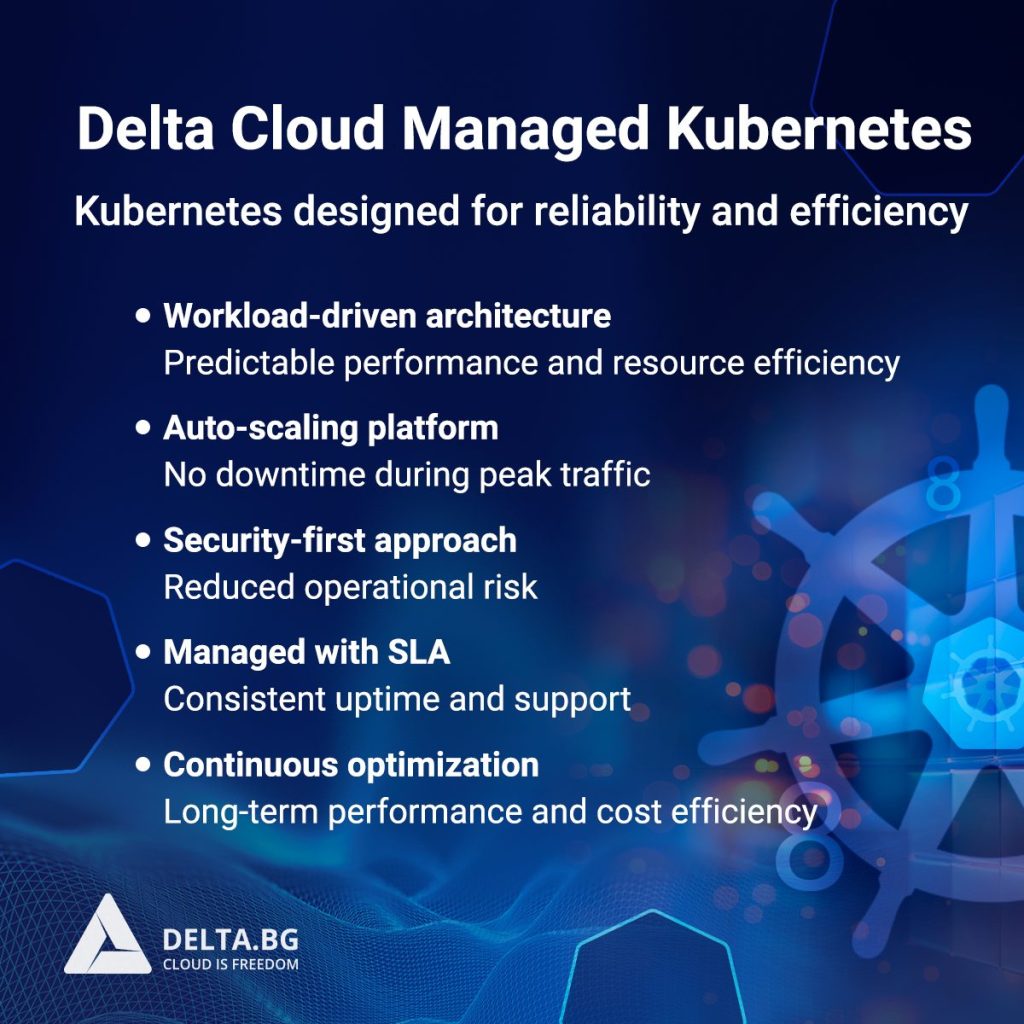
With Managed Kubernetes from Delta, you can easily deploy and manage production-ready Kubernetes clusters running on our cloud platform, Dedicated Servers, or your own infrastructure. Continuous monitoring, automation, and expert support enable you to focus on developing your applications while we manage your Kubernetes environment.
Monolithic Architecture vs Microservices: Key Differences
Monolithic architecture and microservices are both well-established approaches to building modern applications, and each has its own strengths. The right choice depends on your project's complexity, scalability requirements, your team's experience, and your long-term business goals.
| Feature | Monolithic Architecture | Microservices Architecture |
| Codebase | All application components share a single codebase. | Each service has its own independent codebase. |
| Deployment | The entire application is deployed as a single unit. | Each service can be deployed independently. |
| Scalability | The entire application must be scaled, even if only one component requires additional resources. | Each service can scale independently based on demand. |
| Fault Isolation | An issue in one component can affect the entire application. | Issues are typically isolated to the affected service. |
| Team Collaboration | Best suited for small and medium-sized teams working within a shared codebase. | Allows multiple teams to independently develop and maintain services. |
| Infrastructure | Requires fewer components and a simpler infrastructure. | Requires additional infrastructure for communication, monitoring, and orchestration. |
| Operational Complexity | Easier to deploy, manage, and maintain. | Higher complexity due to distributed services and supporting infrastructure. |
Why Do Application Servers Still Matter?
Containers and Kubernetes have transformed the way modern applications are developed and deployed, but they don't replace application servers. While containers provide the runtime environment for applications and Kubernetes automates their management, application servers continue to deliver the enterprise services required by many business-critical applications.
Application servers remain a preferred choice because they:
- Support enterprise technologies, including Jakarta EE and other server-based platforms.
- Provide built-in services for security, transaction management, connection pooling, and resource management.
- Integrate seamlessly with modern containerized and Kubernetes-based environments.
Rather than replacing application servers, containers and Kubernetes complement them by automating application deployment, scaling, and management.
Which Architecture Should You Choose?
Your choice between monolithic architecture and microservices depends on your application's complexity, expected growth, and your team's technical expertise. The following guidelines can help you determine which approach is the better fit for your project.
Choose Monolithic Architecture If:
- You're building a small or medium-sized application with clearly defined business requirements.
- You have a small development team working within a shared codebase.
- You want faster initial development and a simpler deployment process.
- Your application has predictable workloads and doesn't require independent scaling of individual components.
- You prefer simpler infrastructure and easier day-to-day management.
Choose Microservices Architecture If:
- Your application includes multiple independent business capabilities that can evolve separately.
- Different teams need to develop, deploy, and maintain services independently.
- You expect rapid growth or require independent scaling of different components.
- High availability, resilience, and fault isolation are critical requirements.
- Your organization has experience managing distributed systems, containers, and Kubernetes.
Conclusion
Choosing between monolithic architecture and microservices depends on your application's requirements, expected growth, and your team's technical capabilities. Both approaches can successfully support modern applications when combined with the right infrastructure and a well-designed architecture.
Choosing the right infrastructure is just as important as selecting the right architecture. Whether you need the flexibility of a Cloud VPS, the performance of a Dedicated Server, or the scalability of Kubernetes, the Delta team can help you find the solution that best fits your current and future requirements. Contact us at support@delta.bg or call +359 2 4 288 288 to discuss the best infrastructure for your applications.