

Cloud backup pricing is not always as straightforward as it initially appears. Some providers advertise low monthly fees, but actual costs can increase depending on the amount of data stored, backup frequency, and the recovery and security features required.
For individual users, cloud backup services provide an affordable way to protect photos, files, and devices from data loss. For businesses, however, costs tend to rise as data volumes increase and the impact of downtime becomes more significant.
In this guide, we examine the most common pricing models, average costs, and the factors that most influence monthly backup expenses.
Key Takeaways:
Cloud backup services typically cost between €10 and €15 per month for individual users, while business and enterprise solutions can range from hundreds to thousands of euros per month depending on data volume, backup frequency, retention policies, and recovery requirements. Total costs are often influenced by additional factors such as data retrieval fees, archive storage, compliance requirements, and geographic location, making it important to compare pricing models carefully.
Average Cloud Backup Pricing
Cloud backup services use various pricing models, including storage-based billing, per-user subscriptions, and plans based on the number of protected devices. Costs generally increase as storage, recovery, and security requirements grow.
Personal Cloud Backup Pricing
Personal plans are typically the most affordable option, with most services costing between €9.66 and €12.73 per month depending on storage limits and recovery features.
Lower-cost plans usually include basic automatic backups and cloud storage, while higher-tier plans offer longer file version history, ransomware protection, faster recovery, and larger storage capacities. Some providers also offer unlimited plans, although fair-use policies may affect upload speeds or long-term storage availability.
Typical personal backup pricing includes:
- Plans with up to 500 GB of storage for €9.66/month
- Plans with 1 TB or more starting from €12.73/month
Cloud Backup Costs for Small Businesses
Small business backup services are typically billed per user, per device, or based on storage consumption. Most companies pay between €10 and €30 per user per month depending on data volume and recovery requirements.
Business plans generally include centralized management, access controls, and endpoint protection, allowing backup operations to be managed across multiple users and devices from a single platform.
A company with 20 employees may spend between €200 and €600 per month, particularly when backing up databases, virtual machines, or large media files.
Typical business costs include:
- Basic employee backup plans between €10 and €15 per user/month
- Plans with endpoint protection averaging between €15 and €25 per user/month
- Additional costs for servers and virtual machines depending on storage and recovery requirements
Enterprise Cloud Backup Pricing
Cloud backup services for large organizations and enterprises are significantly more expensive because they support large-scale infrastructure, regulatory compliance, and rapid disaster recovery.
Pricing is often based on total data volume, retrieval activity, archival storage tiers, and geographic replication across multiple data centers.
Large organizations frequently pay between €10 and €25 per terabyte per month, although actual costs vary depending on recovery speed requirements, storage architecture, and compliance obligations.
Typical enterprise costs may include:
- Standard cloud backup storage ranging from €5 to €25 per TB/month
- Lower-cost archival storage with slower recovery times
- Higher-cost disaster recovery infrastructure for rapid restoration
- Additional expenses for encryption and compliance in regulated industries
At Delta.BG, we offer fully automated, incremental Cloud Backup solutions that provide reliable backup and protection for your project data.
The price of our Cloud Backup service depends on the plan you choose and the amount of storage required for your data.
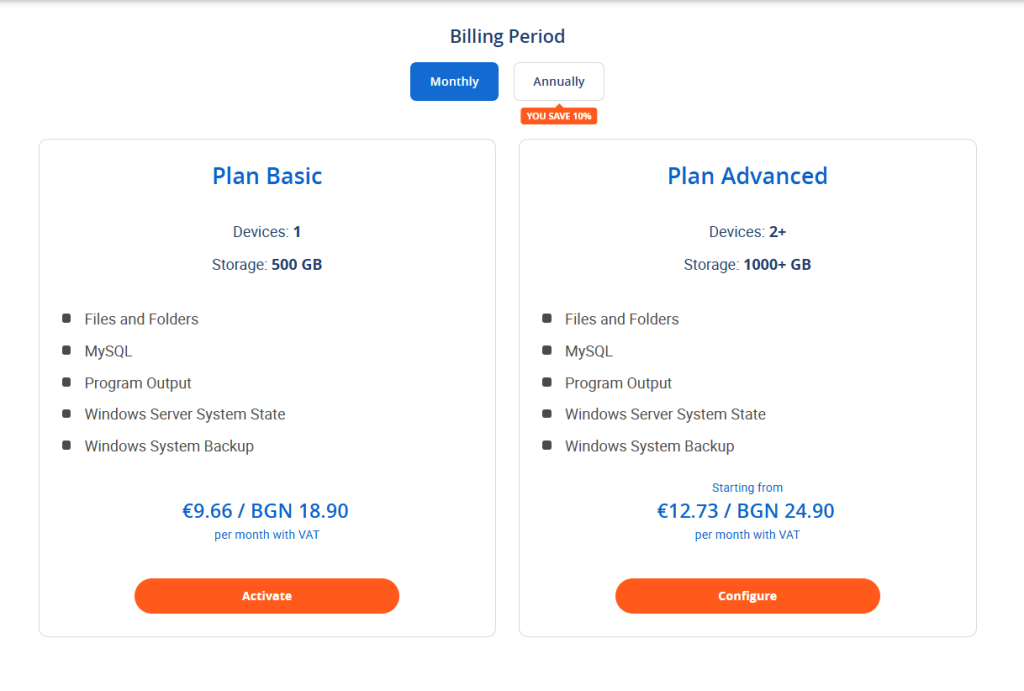
When you choose a 1-year Cloud Backup plan, you receive a 10% discount and the peace of mind that your data is protected with reliable, automated backups and fast recovery when needed.
What Influences Cloud Backup Costs?
Storage Capacity
The volume of stored data is usually the largest pricing factor. Most providers charge based on storage consumption measured in gigabytes (GB) or terabytes (TB). Organizations backing up large databases, media libraries, or video surveillance systems typically pay significantly more than those storing standard documents and photos.
Backup Frequency
More frequent backups cost more because changes must be processed and stored more often. Continuous Data Protection (CDP) is generally more expensive than daily or weekly backup schedules, particularly for businesses that require minimal downtime and faster recovery.
Data Retrieval and Transfer Fees
Some providers charge additional fees when backup data is downloaded or transferred from the cloud. These costs become especially noticeable during large-scale recovery operations following outages or cyberattacks.
Some services separately charge for backup storage and recovery bandwidth, which can significantly increase costs during major restoration events.
Retention Policies
Retention policies determine how long backup versions are stored after files are modified or deleted. Longer retention periods increase storage usage over time because providers continue to maintain historical copies and previous versions of files.
Security and Compliance Requirements
Meeting security and compliance requirements can significantly increase costs. Features such as encryption, immutable backups, ransomware protection, and multi-region redundancy typically require higher-tier plans.
Organizations operating under regulations such as NIS2 or GDPR often pay more for the additional compliance controls and governance requirements involved.
Understanding Different Pricing Models
Fixed Monthly Pricing
This model uses a fixed monthly fee that remains relatively stable regardless of minor fluctuations in storage usage. It is a popular option for individual users and small businesses because it provides predictable costs and easier budgeting.
Pay-As-You-Go Pricing
The pay-as-you-go model charges based on actual storage consumption, data transfer, or backup activity. It is well suited to organizations with fluctuating requirements or rapidly growing data volumes because they only pay for the resources they use.
The downside is that monthly costs can become unpredictable during periods of intensive backup activity or large recovery operations.
Storage Tier Pricing
Many cloud backup providers divide storage into different pricing tiers based on how frequently the data is accessed.
- Hot storage is designed for frequently accessed backup copies and provides the fastest recovery times, but it is also the most expensive option.
- Cool storage is less expensive and suitable for data that is accessed infrequently, although recovery times may be longer.
- Archive storage is the most affordable option for long-term retention, but recovering archived data may take hours or even days.
Hidden Costs of Cloud Backup Services
Some providers may charge additional fees for:
- API requests, especially when backup activity is highly automated
- Early deletion fees when archived data is removed before the minimum retention period expires
- Recovery fees during large-scale restoration operations
- Migration costs when moving data between providers or regions
- Geographic replication across multiple data centers
- Premium support plans that offer faster response times and specialized assistance
How to Reduce Cloud Backup Costs
Reducing backup expenses usually involves optimizing storage usage and avoiding unnecessary backup activity.
Some of the most effective cost-saving strategies include:
- Moving older backup copies to lower-cost archival storage
- Removing duplicate or unnecessary data
- Limiting excessive version retention
- Backing up only critical systems and essential business data
- Using compression and deduplication technologies
- Selecting the appropriate storage tier based on application requirements
Conclusion
Cloud backup pricing varies based on data volume, backup frequency, retention policies, recovery speed requirements, and security needs. Personal plans may cost only a few euros per month, while business and enterprise deployments often become significantly more expensive as storage and recovery requirements grow.
At Delta.bg, we provide scalable cloud backup solutions with incremental backups that capture only changed files, multi-location data storage, and flexible retention management. For more information about our services, contact us at sales@delta.bg or call +359 2 4 288 288. For technical support, email us at support@delta.bg.